
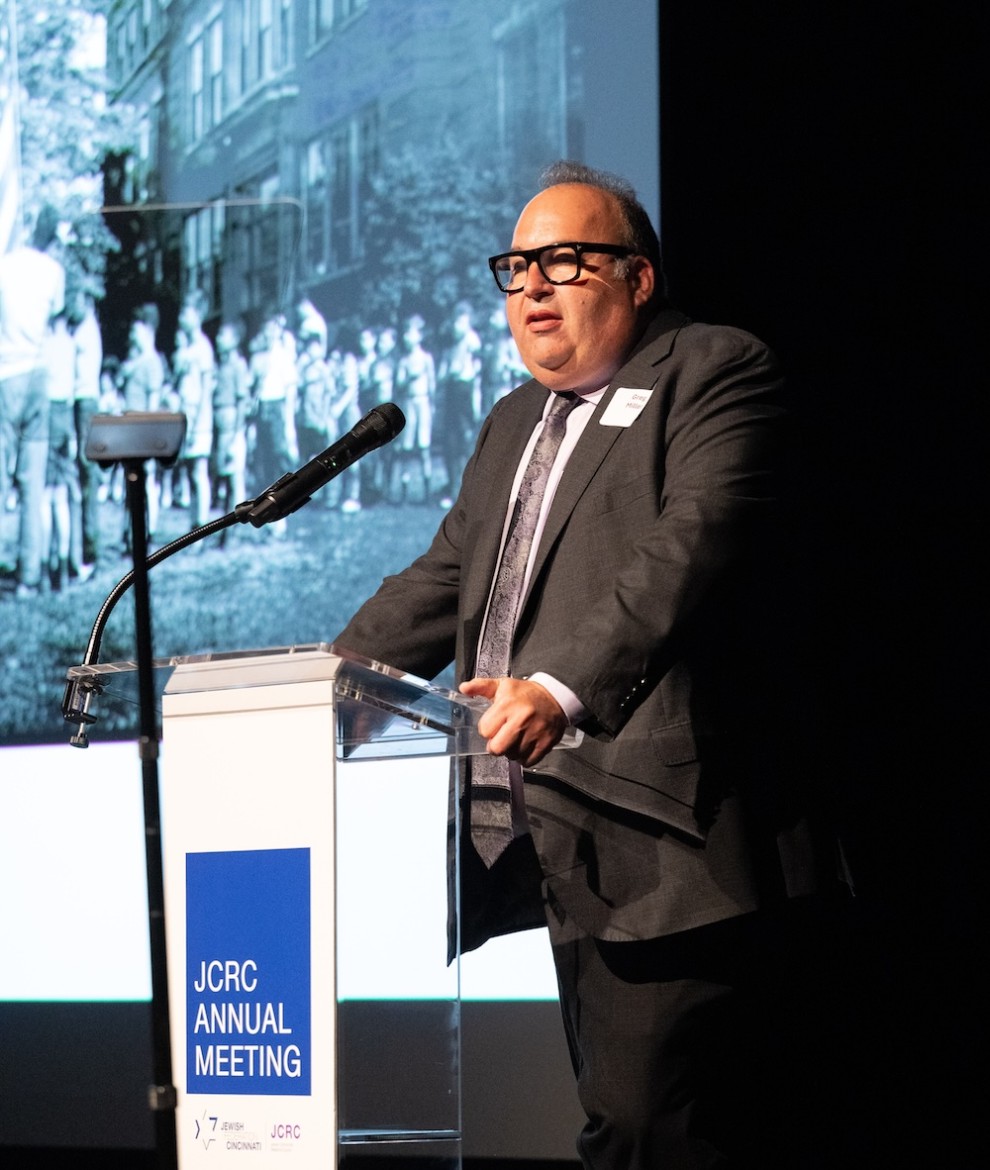
The Jewish Federation of Cincinnati’s Jewish Community Relations Council (JCRC) held its 2026 Annual Meeting on Thursday, April 16, at the Mayerson JCC. The theme was “Newsworthy or Not?” featuring a panel discussion with leading Jewish journalists.
Community members, elected officials, and interfaith partners filed in, greeted by a video montage of stories covered by local news organizations concerning the Cincinnati Jewish community and a compilation of JCRC-related work.
JCRC Chair Greg Miller opened by walking the room back to 1939. Alarmed by world events, five Cincinnati Jews decided their community could no longer afford to be invisible. They founded what is now the JCRC. Miller drew a straight line from that moment to this one. He pointed to swastika flags hung over I-75 near Lincoln Heights last February, to vandalized Jewish cemeteries, and other acts of antisemitism that have occurred locally, as the reason for why JCRC’s work is still so critical.
Federation CEO Danielle V. Minson followed with a briefing that centered on what the Federation and JCRC are doing to enhance Jewish life, despite the challenges. Cincinnati, she noted, built its own security infrastructure in 2012, six years before the attack at Tree of Life. She pointed to the Hanukkah ceremony on the steps of City Hall in December that brought together city leaders, rabbis, and community members, and to the Auschwitz. Not Long Ago. Not Far Away. exhibit at the Cincinnati Museum Center, which drew more than 100,000 visitors, nearly 25,000 of them students, in just six months.
JCRC Director Chandler Waite reported three achievements since he began his tenure nine months ago. He described sitting down with the new Archbishop of the Archdiocese of Cincinnati for the first time, meeting with No Kings protest organizers following antisemitic chants at rallies and entering Sycamore Community Schools to lead a session on antisemitism after more than a decade of trying. He also highlighted the “Black and Jewish America” screening JCRC co-hosted with CET and the Urban League of Southwestern Ohio’s Holloman Center for Social Justice, which sold out. Patience, Waite said, is everything in this work.
The evening’s headline panel turned to how Jewish life gets reported. Kevin Adelstein, CEO of the Cleveland Jewish Publication Company moderated the conversation and “Q & A” session with Jacob Kornbluh of The Forward, who attended in person, and Marc Rod of Jewish Insider, who joined virtually from Washington DC.
The panelists discussed the speed and scrutiny of today’s news cycle, the challenge of covering Israel both supportively and critically, the amplification of sensational content on social media, and the pressure Jewish journalists face to remain unbiased while being visibly part of the communities they cover. Kornbluh spoke about the constant fear many Jewish students carry on campus and the way being Jewish and a Zionist can put a target on a student’s back. Rod addressed the financial incentives that reward sensational coverage, and the heightened scrutiny that now follows every congressional vote he reports on. Both returned to a similar conviction. Staying fair, listening to both sides, and doing the work is how trust gets rebuilt.
JCRC Associate Director Jeremy Spiegel closed the program with the question that tied the night together: “Who tells our story when we’re not in the room?” His answer was the Cohen Family Leaders in Light Institute, the nine-month leadership program JCRC launched in 2019. Two cohorts and forty-seven Fellows later, graduates continue to open doors to interfaith relationships and civic trust. The third cohort launches in September.