
Every candidate the Jewish Federation of Cincinnati interviews for the shlichut position gets the same question. If there is an election in Israel while you are here, how would you explain it to an American audience, and how would you stay impartial?
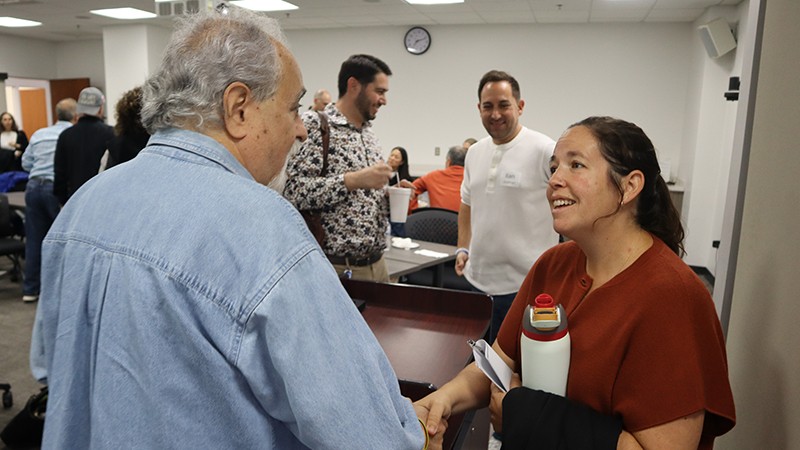
Moria Dafni aced the answer in the interview. Seven weeks after arriving, she answered it again in front of a full room, as the first program she led here.
"Unpacking the Israeli Election, Before the Vote" ran Wednesday, September 23, at the Mayerson JCC, co-hosted by the Federation and the JCC. It is part of IsraelLENS, the Federation's framework for exploring Israel through dialogue, culture, and learning—built on curiosity over certainty.
Curiosity and people filled the room on a Wednesday evening, enough that the partition between the two board rooms had to be opened to make room for everyone. Fresh faces showed up at the same tables as the friends we already see at Israel-related programs. Some came from outside the Jewish community. People stayed well past the last slide, still asking meaningful questions.
Moria set just one ground rule before she started. English is her second language, and election vocabulary is unforgiving, so she asked the room to help if a word got away from her, and the room graciously accepted. Judicial. Precinct. It was endearing and engaging at the same time.
Who she is
Moria is the Federation's new Community Shlicha, here on a two-to-three-year term through the Jewish Agency for Israel, which has brought shlichim to Cincinnati since the 1990s.
She was raised on a kibbutz in northern Israel and has spent 20 years in Jewish education, starting as a teenage counselor. She directed programming across 60 Jerusalem schools, then spent three years helping northern municipalities rebuild school systems in evacuated communities, so young families would have somewhere to come back to. She arrived in August with her husband, Asaf, and their children. Asaf has served more than 500 days of reserve duty since October 7.
She told the crowd she came to share an Israel of responsibility, resilience, education, and arvut, the obligation Jews carry for one another.
One line on the ballot
An Israeli ballot has one thing on it: a party name. There are no districts. The whole country votes as one constituency, and 120 Knesset seats are handed out in proportion to the national vote.
Each party files a ranked list of candidates, seven weeks before the October 27 vote. Once filed, it is frozen. Voters cannot move a name up, pull a name out, or split a vote between two parties they like. If a party wins four seats, the first four names enter the Knesset. Names five and six go home.
The math is the whole game
One rule shapes everything else. A party has to clear 3.25 percent of the valid ballots to enter the Knesset at all. Clear it and you get seats in proportion to your votes. Miss it and you get nothing, and every ballot cast for you is set aside.
Moria walked the room through what that meant in 2022. About 4.8 million Israelis voted, so 3.25 percent came to roughly 155,000 votes. Once the parties that cleared the bar divided up the seats, each seat had cost about 36,200 votes. And about 420,000 votes went to parties that fell short, close to one in eleven ballots cast, roughly 11 seats worth of turnout that ended the night with nobody in the Knesset.
The threshold has not stopped people from trying. Thirty-eight parties filed lists, among them a Pirates party and a party organized around opposing vaccines. And every ballot is counted by hand, through the night, in the country that markets itself as the startup nation. That got a laugh.
Nobody has ever won a majority
No single party has ever won 61 of the 120 seats. The high-water mark is 56, in 1969. So, every Israeli government has been a coalition: parties pooling seats to get past 61 and dividing up the ministries in a written agreement. The election is the first half. The second half starts the morning after the count.
In the United States you vote for the head of government directly. In Israel you vote for a party, and the head of government is settled afterward, when the president hands one candidate 28 days to assemble a coalition holding at least 61 seats. It goes to whoever can credibly get there, which is not always the party that won the most seats. In 2021, it produced a prime minister whose own party had won 7 of the 120 seats. That was Naftali Bennett, who is running again this year.
That’s why the parties closest to the threshold line matter most right now. If one falls short, its votes are thrown out; the seats get divided among the parties that did clear the bar, and the whole map shifts.
What Israelis are actually arguing about
Moria named six issues driving this campaign:
- Who carries the burden of military service. Reservists have served hundreds of days since October 7 while most Haredi men do not serve at all. The exemption dates to the founding of the state, when the Haredi community was a much smaller fraction of the population and the priority was preserving Torah study after the Holocaust. It is now a large and fast-growing share. Haredi families, for their part, have spent decades experiencing integration as pressure to abandon their traditions, and any workable answer has to be built with them rather than imposed on them.
- Gaza and the West Bank after the war. What the day after looks like, and who administers it.
- Jewish and democratic. Marriage, burial, and much of civil life run through religious authority, and the judicial reform fight is still in the room.
- Governance and personal security. Violence in the West Bank, crime in Arab communities, and a broad sense that ordinary life is less safe than it was.
- The cost of living. Moria named the three items an Israeli household notices first: Bamba, the peanut puff in every Israeli pantry, feta, and cottage cheese. Cottage cheese is its own political category. In 2011 a Facebook boycott over the price of a single container grew into the largest cost-of-living protests the country had seen.
- The October 7 commission of inquiry. The fight is over who chairs it. The government does not want one headed by the Supreme Court. The opposition does not want one headed by politicians. The inquiry has not started.
Who is running
Families who lost someone on October 7 are now Knesset candidates, spread across lists that agree on almost nothing. Gadi Eisenkot, the former IDF chief of staff whose son Gal was killed in Gaza, heads one of them. Others include a former mayor from the prime minister’s own party, the brother of two hostages, and the mothers of young men killed that day.
And a 23-year-old could become the youngest member of Knesset in Israel's history. Yonatan Shalev was born in Baltimore, served in an IDF special forces unit, and has spent hundreds of days in reserves since October 7. In 2024 he helped found Katef el Katef, Shoulder to Shoulder, when reservists began organizing against broad draft exemptions. He now chairs it, and he sits tenth on a joint list headed by former prime ministers Naftali Bennett and Yair Lapid. Whether he gets in is the closed-list math from earlier: the list must win ten seats.
What happens next
Israel votes October 27. The government that follows will take at least 28 days to assemble.
Moria votes October 15 at the Israeli consulate in Chicago, along with every other emissary in the region. Israelis voting away from home use a double envelope, checked against the rolls before the inner ballot joins the count. Soldiers, diplomats, and prisoners vote the same way, which is why those ballots are counted last.
Learning the ins and outs of Israel’s election system has changed dramatically in the last few decades. Before the Federation began hosting shlichim in the 1990s, a Cincinnatian curious about Israel likely relied on a mailed subscription to an English-language Israeli newspaper. Today, everyone has access to news feeds full of Israel and a lot of it is wrong. And a news feed can’t take a follow-up question or give you a first-hand account of what election day feels like. That is what the room turned out for on a Wednesday evening.
The next one is Thursday, November 5, at the Mayerson JCC, when Elior Levy and Rabbi Liz P.G. Hirsch join us to talk through the results. Please register here. Levy covers Palestinian affairs for Kan 11, Israel's public broadcaster, and will join us live from Israel. Rabbi Hirsch is the CEO of Women of Reform Judaism and will offer insight into what the results could mean for our Jewish community in the U.S.